Rising damp treatment in Teesside
A new chemical damp proof course injected into the mortar bed, followed by removal and renewal of the salt-contaminated plaster above it, prices at £70 to £120 per linear metre of wall on Teesside. The critical part happens before any of that: proving the wall is genuinely suffering rising damp rather than a bridged course or a leak.
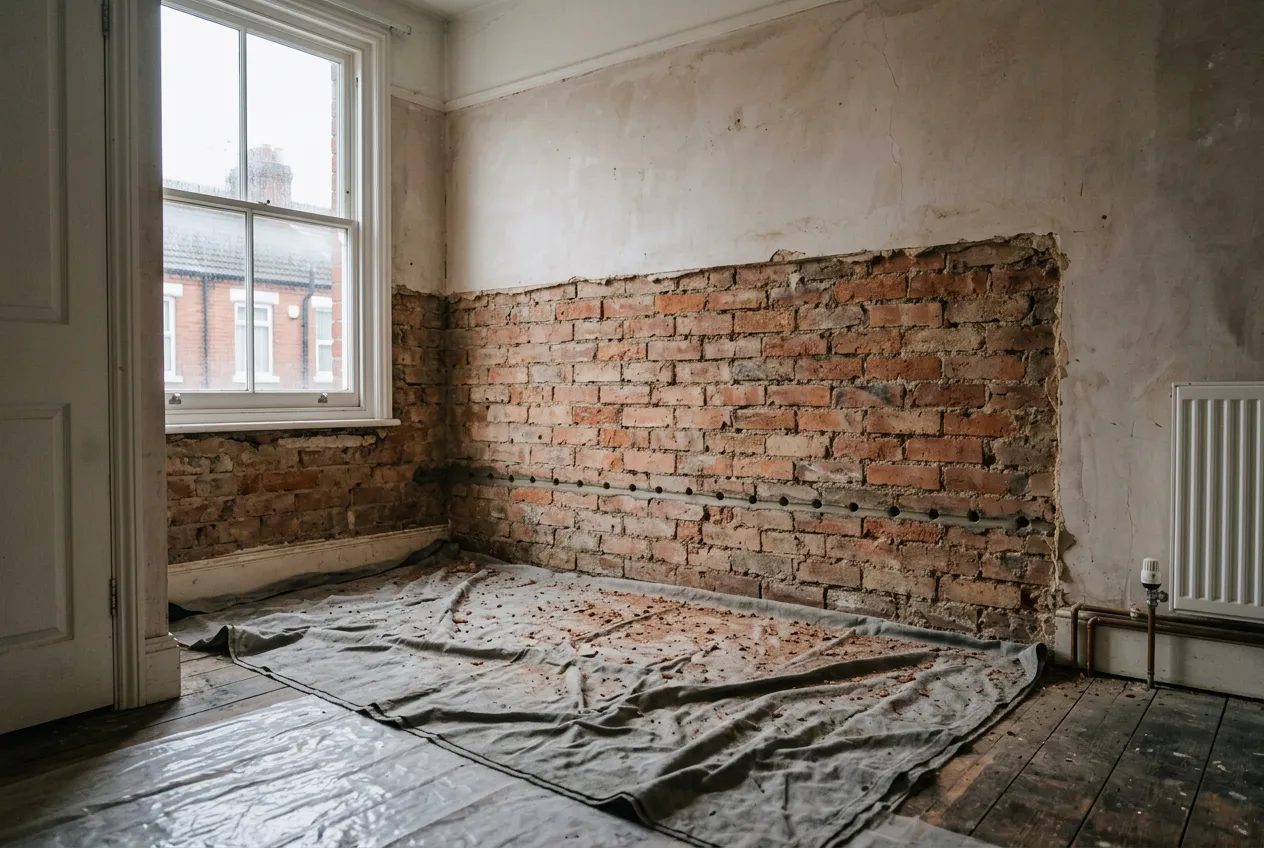
What rising damp actually is
Groundwater moves upward through the fine pores of brick and mortar by capillary action, in the same way a paper towel wicks a spill. In a house with a working damp proof course the barrier stops it a few brick courses above ground. Where that barrier is a Victorian slate bedded in lime that has cracked along its length, a bituminous felt that has gone brittle, or nothing at all, the moisture keeps climbing until gravity and evaporation balance it out, typically somewhere between 600mm and 1.2 metres above floor level.
It arrives with a signature. A horizontal tide mark, more or less level along the wall regardless of what is above it. A band of hygroscopic salts, mainly nitrates and chlorides carried up out of the ground, which blow the plaster and leave a fluffy white bloom. Skirtings that are soft at the back. And a problem that gets slightly better in a dry summer without ever going away.
Why the diagnosis comes first
Rising damp is real, and in the pre-1919 terraces around Gresham, North Ormesby, central Stockton and the older Hartlepool streets it turns up regularly. It is also over-diagnosed, because three far more common faults produce a similar-looking damp band at the base of a wall:
- A bridged damp proof course. A drive, patio, raised border or render coat carried down past the course lets moisture step over the barrier. On Teesside this is the single most frequent cause of "rising damp", and the fix is a spade and a grinder, not an injection lance.
- An external leak at low level. A cracked gully, a downpipe discharging into a blocked drain, or a leaking rising main under the floor.
- Salt-contaminated plaster from a historic problem. The wall has dried, but the salts left behind pull moisture out of room air and read wet on any meter forever.
A proper diagnosis uses more than an electrical moisture meter. Ground levels are measured against the internal floor. Drilled samples from the wall's depth are tested by carbide meter or oven-dried in a laboratory to separate moisture content from salt content. Only then does injection make sense. See damp surveys and reports if you want that done by someone who is not quoting for the treatment.
How a chemical damp proof course is installed
| Stage | What happens |
|---|---|
| Preparation | Plaster stripped back a minimum of 500mm above the visible damp, skirtings and fixings removed |
| Injection | 12mm holes drilled at 120mm centres into a single mortar bed, silane or siloxane cream injected to fill each hole |
| Curing | Cream diffuses into the mortar and cures to form a water-repellent band through the wall |
| Replastering | Salt-retardant render coat, typically a sand-cement mix with additive or a proprietary renovating plaster, finished with a skim |
| Drying | Around one month per 25mm of wall thickness before decorating, using breathable paint at first |
Cream injection has largely replaced pressure-injected fluids because it delivers a consistent dose without flooding the wall. On a solid nine-inch wall the holes go right through from one side; on a cavity wall each leaf is treated separately, and the cavity is checked for mortar snots bridging it.
Prices for Teesside houses
Costs run £70 to £120 per linear metre where the price includes injection and replastering, and £25 to £45 per metre for injection alone. Practical examples: a single 4m front room wall, £350 to £550. Front and party walls in a mid-terrace lounge, roughly £700 to £1,300. A full ground floor of a small terrace, 22 to 30 linear metres, £1,800 to £3,400. Removing and disposing of a raised concrete drive that bridges the course adds £400 to £900 but often removes the need to inject at all.
Guarantees and standards
The work should be specified and carried out in line with BS 6576, and the guarantee should be a 20 or 30 year insurance-backed policy issued through an independent provider, not a letter from the contractor. Property Care Association membership and a CSRT-qualified surveyor are the usual markers of a firm whose guarantee an insurer will actually underwrite.
Living with a treated wall
A newly replastered wall holds a large amount of construction water on top of whatever it is still releasing. Decorating too early traps it, blisters the paint and produces a callback that looks like treatment failure. Ventilate the room, keep gentle background heat on, and use a breathable emulsion for the first year. Avoid vinyl paper and oil-based paints on the treated area entirely.