Condensation control in Teesside
Condensation is moisture generated inside the house settling on cold surfaces, and it causes the majority of black mould in Teesside homes between October and March. Fitting humidity-sensing extraction at £180 to £350, positive input ventilation at £600 to £1,200, or treating the cold spots themselves deals with it permanently, unlike wiping the mould off.
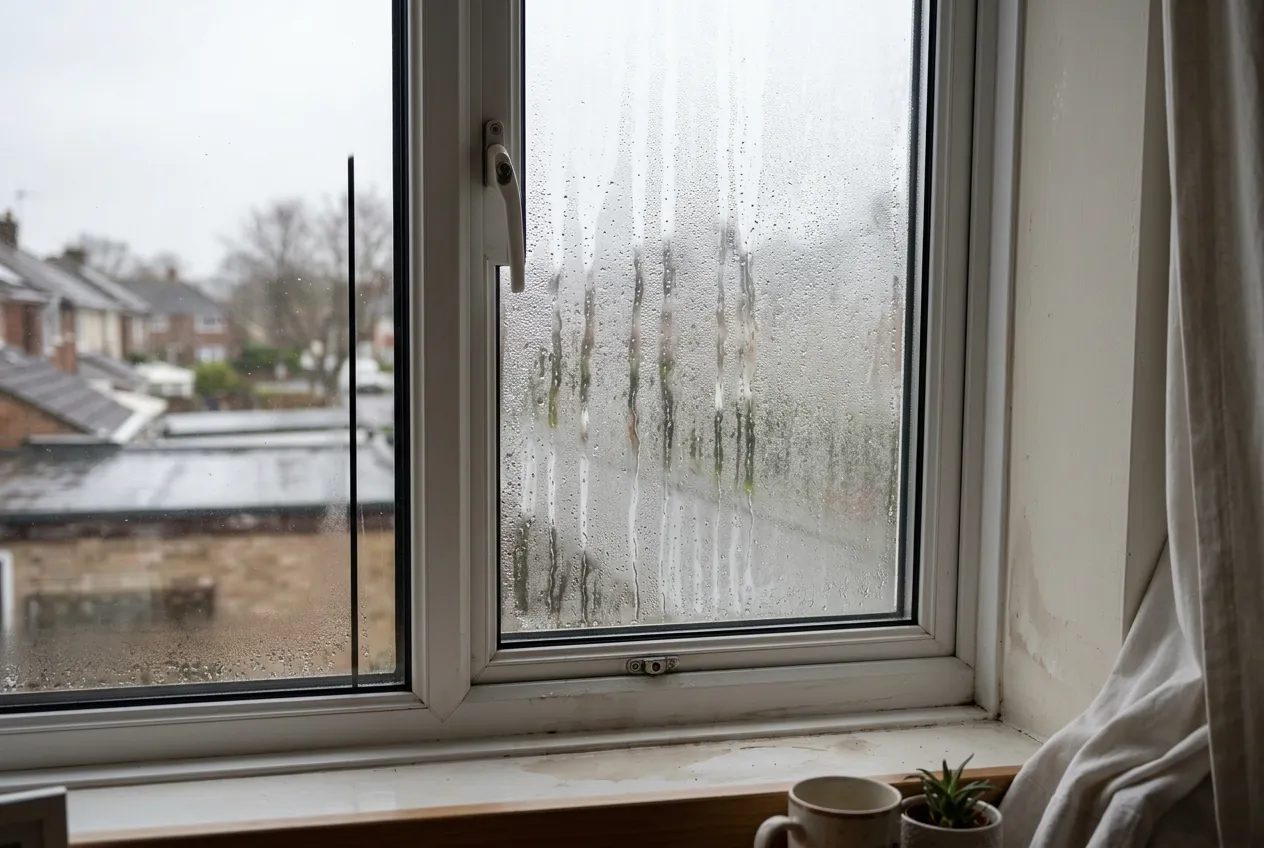
Where the water comes from
An average household puts somewhere between 10 and 15 litres of water vapour into the air every day: four people breathing, showers, cooking, kettles, washing, and above all drying clothes indoors. Air can only hold so much vapour at a given temperature, and when warm moist air touches a surface below its dew point the water comes back out as liquid. That surface is usually the coldest one in the room, which is why it always seems to be the same three places: the external corner of a bedroom, the window reveal, and the wall behind a wardrobe pushed tight against the outside wall.
Teesside makes this worse in two ways. Winter humidity is high across the whole conurbation because of the coast and the river, so opening a window on a damp January day imports moisture rather than removing it. And a great many local houses have been part-improved rather than fully improved: new glazing and a filled cavity, but a solid brick return, an unheated back bedroom, or an old bathroom fan wired to the light switch that anyone with any sense turns off.
The three levers
| Measure | What it does | Guide price |
|---|---|---|
| Humidity-sensing extractor fan | Removes moisture at source in kitchen or bathroom, runs on humidity not the light switch | £180 to £350 fitted |
| Continuous low-rate dMEV fan | Runs quietly all the time, boosts on demand, ideal in bathrooms | £250 to £450 |
| Positive input ventilation (PIV) | Loft-mounted unit gently pressurises the house with filtered, tempered air | £600 to £1,200 installed |
| Heat recovery unit (MVHR or single room) | Ventilates while retaining most of the heat | £350 per room to £4,000 whole house |
| Cold-spot insulation, thermal lining | Raises the surface temperature so vapour stops condensing there | £40 to £90/m² |
| Trickle vents to existing windows | Restores background ventilation lost when glazing was replaced | £35 to £70 per window |
What actually works, in what order
Extraction at source first, because it is cheap and it removes the moisture before it travels. A bathroom fan should be humidity-controlled with an overrun, ducted the shortest route to outside in insulated rigid duct, and never terminated into the loft. A kitchen extractor needs to be ducted out too, and a recirculating cooker hood, common in Teesside kitchen refits, removes grease and no water at all.
Whole-house ventilation next. A PIV unit in the loft is the standard retrofit answer for a three-bed semi with mould in two bedrooms, and it does something a fan cannot: it dilutes moist air across the entire house continuously. Expect £600 to £1,200 fitted, running costs of a few pounds a month, and a noticeable difference within a fortnight.
Warmth and insulation last, because it is the most expensive lever. Insulated plasterboard or an insulating render to a cold external corner raises the surface temperature above the dew point permanently. It also has to be detailed properly around the edges, or the cold bridge simply moves to the boundary of the new lining.
The habits that genuinely matter
- Dry washing outdoors or in a vented tumble dryer. A single load dried on an indoor airer releases around two litres of water into the house.
- Shut the bathroom door while showering and for fifteen minutes afterwards, with the fan running.
- Leave a 50mm gap behind wardrobes and beds on external walls so air can move.
- Keep low background heat in unused bedrooms rather than heating them from cold twice a day.
- Do not block airbricks or seal every trickle vent. Airtightness without ventilation is how a well-insulated house grows mould.
Advice about habits should come alongside the physical measures, never instead of them. Where a landlord's only response to mould is a leaflet about opening windows, that is not a repair, and under the damp and mould standards now applied to rented housing in England it is unlikely to satisfy an inspection either.
When it is not condensation
If the damp is a level band at the bottom of the wall, look at rising damp. If it is a defined patch that darkens after driving rain, look at penetrating damp. And where mould is already established, the surfaces still need treating and redecorating once the ventilation work is done.