Penetrating damp repairs in Teesside
Penetrating damp is water crossing the wall from outside through a physical fault, so the repair is a building repair: repointing at £45 to £90 per square metre, render patching at £60 to £120, gutter and sill work from around £90. Coastal and exposed elevations across Redcar, Saltburn and the Hartlepool Headland are where it concentrates.
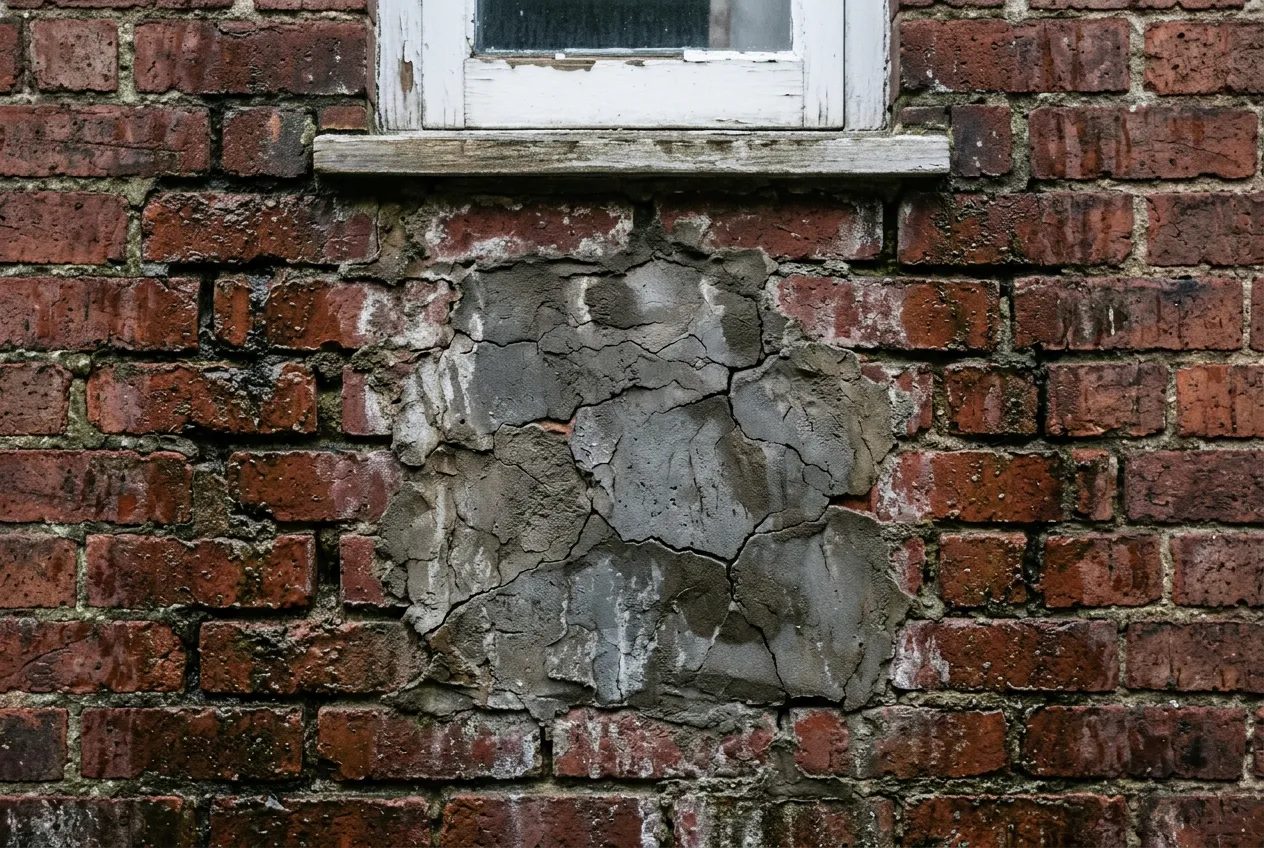
How penetrating damp behaves
It shows as a defined patch rather than a level band, and it moves to the weather. A wall that darkens within a few hours of a north-easterly gale and fades over the following week is telling you exactly what it is. The patch usually sits opposite the defect, so a stain in the middle of a chimney breast points at flashing or a pot, a stain under a window points at the sill or its end joints, and a stain that follows a diagonal line points at a leaking internal pipe rather than the weather at all.
Teesside gets a specific version of this problem. Wind-driven rain arrives off the North Sea and hits north and east elevations hard, and salt in that rain keeps the brick face damp for longer than fresh water would. Streets in Redcar, Marske, Saltburn and the Headland at Hartlepool have elevations that are effectively rain-lashed for months, while a sheltered south-west wall three miles inland stays dry through the same winter.
The usual faults, in order of frequency
| Fault | Sign inside | Guide price |
|---|---|---|
| Blocked or split gutter, leaking joint | Vertical damp stripe, worst after rain | £90 to £250 |
| Eroded or open mortar joints | Broad diffuse patch on the weather elevation | £45 to £90/m² repointed |
| Cracked or hollow render | Patch that traces the crack line | £60 to £120/m² |
| Failed window sill or missing drip | Damp below the window, both corners | £150 to £450 |
| Mortar bridging the cavity | Isolated patch mid-wall, no external clue | £250 to £700 to clear |
| Defective cavity wall insulation | Widespread patches on one exposed elevation | £1,500 to £4,000 to extract |
| Chimney flashing or perished pot | Staining to breast, often upstairs first | £300 to £900 |
The cavity wall insulation question
Thousands of Teesside semis and terraces were filled under grant schemes from the 1990s onward, and on a severely exposed elevation the fill can act as a bridge: rain that used to run down the inside face of the outer leaf and drain away now soaks the fill and reaches the inner leaf. The symptoms are distinctive, namely damp appearing across a whole elevation a year or two after the fill went in, and always the elevation that faces the prevailing weather. Where that is the case, extraction of the fill plus repointing and a breathable water-repellent treatment is the correct route, and any surviving guarantee from the installing scheme is worth chasing before paying for it yourself.
What a repair job looks like
Find the fault, fix the fault, then deal with the wall. In that order. Drying a saturated solid wall takes weeks, so a good contractor will remove the damaged plaster, allow the masonry to dry with heat and air movement, and only then replaster. Sealing a wet wall behind a waterproof render or an internal tanking slurry is a shortcut that pushes the moisture sideways and reappears at the edge of the treated area.
Facade protection creams have a place once the masonry is sound: a breathable silane or siloxane treatment at £25 to £45 per square metre significantly reduces water uptake on exposed brickwork while still letting vapour out. Applied to defective pointing or cracked render, it does nothing useful and traps what is already inside.
Do not confuse it with the other two
If the damp band is level and low, look at rising damp treatment. If black spot mould appears in corners and on window reveals through the winter with no external fault to be found, the answer is condensation control. Penetrating damp is the one that responds to the weather within hours, and the one where a set of ladders and a torch usually finds the answer inside an hour.